How accurate is BBT for confirming ovulation?
Basal body temperature tracking is useful for recognising a sustained post-ovulation temperature shift, but it is not an exact ovulation timestamp. Progesterone normally raises resting temperature after ovulation, so the pattern becomes meaningful retrospectively when several higher readings appear after a lower-temperature phase.
The biggest factor in manual BBT accuracy is consistency. A chart can become difficult to interpret when measurement time, sleep, illness, alcohol or the measuring method changes from day to day.
For the broader science and cycle pattern, start with our complete BBT tracking guide.
What affects BBT accuracy?
If you want the bigger framework before troubleshooting individual readings, our history of fertility tracking explains why BBT remains useful, and our Tempdrop vs Oura Ring comparison shows how two modern wearable approaches differ.
Sleep and waking
Broken sleep, very short sleep or a substantially different wake time can affect a manual reading. Note the disruption rather than automatically discarding the whole chart.
Alcohol and illness
Alcohol, fever and illness can alter body temperature. Mark affected readings so you do not mistake a temporary rise for a cycle shift.
Measurement method
Use the same thermometer, body site and general routine. Switching from oral to another measurement site mid-cycle makes readings harder to compare.
Medication and hormones
Some medicines and hormonal treatments can influence temperature or the menstrual cycle itself. BBT should not be used to interpret medication effects without clinical advice.
What is the best time to take BBT?
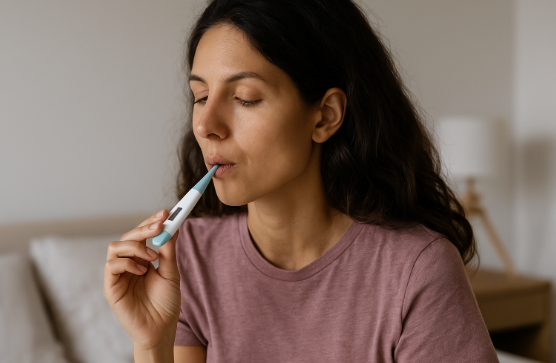
For manual charting, take your temperature immediately after waking and before getting out of bed, using the same method each day. A broadly consistent wake time helps reduce noise, but there is no evidence-based rule that a reading becomes useless because it was taken exactly 20 or 30 minutes later.
If your schedule varies, record the time beside the reading. Patterns across several days matter more than trying to force every morning into perfect conditions.
Does BBT have to be taken at exactly the same time?
No single minute is mandatory, but consistency improves comparability. If your wake time changes substantially, shift work is common or sleep is frequently interrupted, a manual chart may be noisier.
That is one reason some people prefer an overnight wearable: it automates data collection rather than depending on one waking measurement. It does not mean every wearable is inherently more accurate than every basal thermometer.
Can room temperature, blankets or a partner affect BBT?
Environmental conditions can influence how comfortable you feel and may affect peripheral temperature measurements, but ordinary changes in blankets or bedroom temperature do not have a simple, predictable effect on every person's oral BBT.
If something unusual happened, such as sleeping in a much hotter room, being unwell or having severely disrupted sleep, annotate the chart. Do not automatically “correct” the number using an internet formula.
How to make BBT tracking more reliable
- Use the same thermometer or device consistently.
- Measure immediately after waking if using a manual thermometer.
- Keep the measurement site consistent.
- Record unusual sleep, alcohol, illness, travel or medication changes.
- Look for a sustained pattern rather than reacting to one high or low point.
- Use cervical mucus or another validated fertility sign if you need real-time information before ovulation.
If you are choosing between methods, our wearable BBT tracker vs thermometer comparison explains the trade-offs.
BBT accuracy: common questions
Can BBT confirm ovulation?
A sustained higher-temperature pattern can support retrospective confirmation that ovulation probably occurred. It does not prove the exact hour or day the egg was released.
Can one bad night's sleep ruin a BBT chart?
No. One unusual reading is usually less important than the wider pattern. Mark the disturbance and keep tracking.
How accurate is BBT for predicting ovulation?
BBT is not primarily a prediction tool. The temperature rise happens after ovulation, so it is better suited to retrospective confirmation than advance prediction.
Should I adjust a late BBT reading?
There is no universal adjustment formula that reliably converts a later reading into what your temperature “would have been”. Record the actual reading and time instead.
Overnight temperature tracking
If pregnancy is the goal, see how to use Tempdrop while trying to conceive. The BBT download guide gives you a quick charting reference, while the ovulation testing collection lets you compare tools that can identify the fertile window earlier than a post-ovulation temperature rise.
Tempdrop is one option for people who want automated overnight temperature collection rather than a manual waking reading. Its main practical advantage is convenience for variable sleep and wake schedules.
VIEW TEMPDROP
The bottom line
BBT is most useful when it is treated as a trend, not a precision test. Consistent measurement can help you identify a post-ovulation shift; sleep, illness, alcohol and changing routines can add noise.
If fertility decisions depend on exact timing or you have irregular cycles, persistent symptoms or difficulty conceiving, use BBT as supporting information rather than a substitute for appropriate clinical assessment.