Tempdrop vs Oura Ring for cycle tracking: what is the difference?
If you are still deciding whether wearable temperature tracking is right for you at all, start with our complete BBT tracking guide and the deeper explainer on how accurate BBT tracking can be. The history of fertility tracking also shows what wearables changed and what they did not.
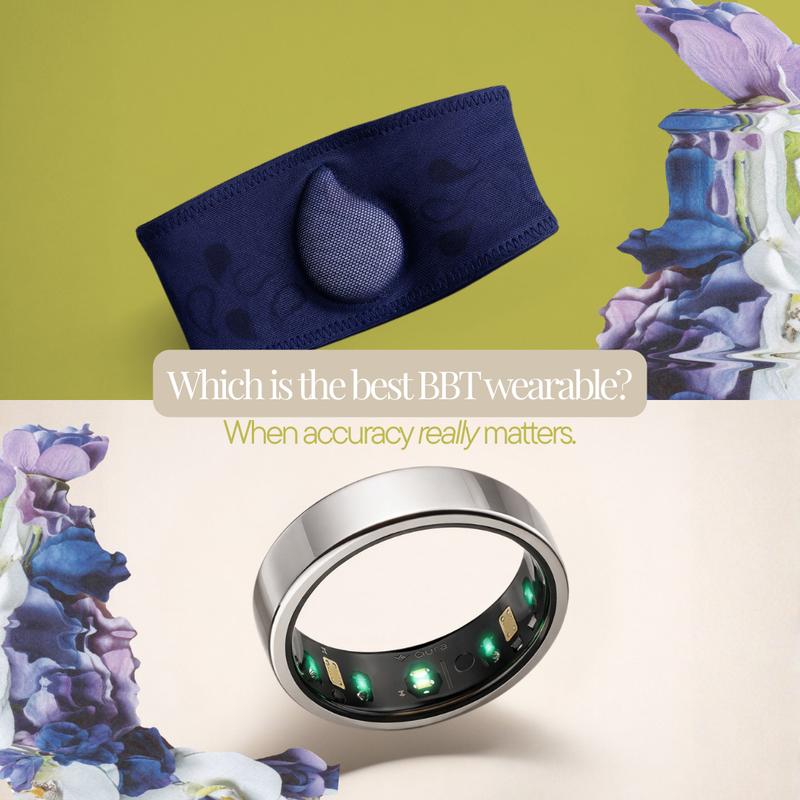
If you are comparing Oura Ring vs Tempdrop, both devices can now contribute useful temperature-led cycle information, but they are built around different primary use cases.
Tempdrop is a fertility-focused upper-arm wearable built around overnight temperature tracking. Oura Ring is a broader health and sleep wearable whose current Cycle Insights feature uses temperature trends and other data to map cycle phases, estimate fertile-window timing and predict periods.
The useful question is therefore not whether one device can track cycles and the other cannot. In 2026, both can. The better fit depends on whether you want a dedicated fertility-tracking device or a broader wellness wearable that also includes cycle features.
Does Oura Ring track BBT?
Oura measures finger temperature throughout the night and reports temperature variation relative to your personal baseline. Oura describes its cycle features in terms of nightly temperature trends rather than a traditional oral BBT reading taken on waking.
Its current Cycle Insights feature uses temperature deviations to help track follicular and luteal phases, predict periods and show a fertile window for users with a natural hormonal cycle. Oura also offers integration with Natural Cycles for people who want that separate regulated service.
So the answer to searches such as “does Oura Ring track BBT?” is nuanced: Oura tracks overnight temperature trends that can support cycle insights, but it is not the same measurement process as taking a conventional basal thermometer reading on waking.
How Tempdrop tracks temperature
Tempdrop is worn on the upper arm during sleep. It collects overnight temperature data and processes those readings into a nightly value for cycle charting.
Its current app includes temperature trend charts, period and symptom logging, ovulation prediction and confirmation, fertile-window forecasts and cycle-pattern tools. The practical advantage is automation: you do not need to wake at the same time each morning to take a manual temperature.
For a broader comparison of overnight wearables and traditional thermometers, see our BBT wearables vs thermometers guide.
Tempdrop vs Oura Ring: side-by-side
Tempdrop
Primary focus: fertility and cycle tracking.
Wear location: upper arm.
Temperature use: overnight data processed for cycle charting.
Best fit: people who mainly want fertility-awareness and cycle data without a strict morning thermometer routine.
Oura Ring
Primary focus: sleep, recovery, activity and broader health, with integrated Cycle Insights.
Wear location: finger.
Temperature use: nightly temperature deviations combined with other biosignals.
Best fit: people who want one broader wellness wearable and also value menstrual-cycle insights.
Can either device confirm ovulation?
A sustained temperature shift after ovulation can provide retrospective evidence that ovulation probably occurred. Temperature is much better at confirming a pattern after the event than at identifying the exact moment an egg was released.
Tempdrop is explicitly designed around fertility tracking and its app includes ovulation confirmation. Oura's current Cycle Insights also includes ovulation detection and fertile-window information for eligible users with natural cycles.
Neither wearable is a substitute for clinical fertility assessment, and a temperature pattern alone should not be used to diagnose a hormonal condition.
Which is better for trying to conceive?
For readers actively timing intercourse, ovulation and fertility tests can provide earlier fertile-window information than temperature alone. Our BBT download guide is also useful if you want a simple reference for interpreting a temperature pattern over time.
If your main objective is dedicated fertility tracking, Tempdrop's narrower focus may suit you better. If you already want Oura for sleep, readiness and general health, its current cycle tools mean you may not need a second wearable simply to see temperature-led cycle trends.
If you are trying to conceive, combine temperature data with real-time fertility signs where appropriate. BBT-style temperature tracking is primarily retrospective, so our Tempdrop when trying to conceive guide explains how it can fit into a wider tracking approach.
Explore Tempdrop
Tempdrop is the fertility-focused option we stock at femme. It is designed for overnight temperature tracking without requiring a same-time-every-morning manual reading.
VIEW TEMPDROP
Oura Ring vs Tempdrop: quick questions
Does Oura Ring measure basal body temperature?
Oura measures overnight finger temperature and reports deviations from your baseline. That is useful for cycle analysis, but it is not the same measurement method as a conventional waking BBT thermometer.
Does Oura Ring track ovulation?
Oura's 2026 Cycle Insights includes ovulation detection, cycle phases and fertile-window information for eligible users who are not using hormonal contraception.
Is Tempdrop only for trying to conceive?
No. It can also be used for general cycle tracking and fertility awareness. The device is simply more specialised around reproductive-cycle tracking than a broad wellness wearable.
Do I need both?
Usually not. Choose the device whose wider feature set fits your goals unless you have a specific reason to compare data from two systems.
The bottom line
Tempdrop vs Oura Ring is now a comparison between two legitimate cycle-tracking approaches, not fertility tracking versus no fertility tracking. Tempdrop is more specialised; Oura is broader. Both use overnight temperature data, but they measure at different body sites and interpret the data within different product ecosystems.
Choose based on the information you actually want every day, not on the assumption that one technology is universally more accurate or capable.