Lion's Mane: why is everyone talking about it?
From its distinctive appearance to growing scientific interest in its naturally occurring compounds, Lion's Mane has become one of the most talked-about functional mushrooms. But what makes it so interesting, and why are researchers paying attention?
KIKI Health supplied the ingredient, cultivation, extraction and formulation expertise for this guide. femme has presented the article in our editorial format and linked the underlying published research so you can explore the science directly.
With conversations around memory, concentration and mental clarity becoming increasingly prominent, particularly among women navigating perimenopause and menopause, Lion's Mane is attracting renewed interest.
At KIKI Health, the approach is that understanding an ingredient is an important part of choosing well. Here is a closer look at this distinctive mushroom, the science behind it and what to consider when choosing a supplement.
What is Lion's Mane?
Lion's Mane (Hericium erinaceus) is an edible mushroom recognised by its long, cascading white spines, which give it an appearance similar to a lion's mane.
Naturally found growing on hardwood trees across Asia, Europe and North America, it has a long history of use in traditional Asian food and wellness practices.
Its composition makes it particularly interesting to researchers, with several naturally occurring compounds identified:
Structural polysaccharides found within mushroom cell walls.
Compounds associated with the mushroom's fruiting body.
Compounds primarily associated with the mycelium.
Including sterols, phenolic compounds and additional polysaccharides.
These compounds are helping researchers better understand the biological properties of Lion's Mane.
Why is Lion's Mane attracting so much interest?
One of the most interesting areas of Lion's Mane research involves the brain and nervous system.
Scientists have investigated certain compounds found in the mushroom for their interactions with nerve growth factor, or NGF, a protein involved in the development, maintenance and survival of nerve cells.
Laboratory studies have explored how compounds associated with Lion's Mane interact with pathways involved in nerve cell development and function. This has opened up an interesting area of research, with scientists continuing to investigate the mushroom's biological properties and potential applications.
Lion's Mane and women's midlife health
For many women, perimenopause and menopause are accompanied by changes in memory, concentration and mental clarity.
Often described as brain fog, these experiences are increasingly recognised as part of the menopause transition. Commonly reported changes include:
- difficulty concentrating or maintaining focus
- forgetfulness and occasional memory lapses
- losing a train of thought
- changes in sleep and mood that can influence mental clarity
The NHS identifies difficulties with memory and concentration among the symptoms women may experience during perimenopause and menopause.
As awareness of these changes grows, so does interest in research exploring cognitive function and the nervous system. Lion's Mane is one ingredient attracting attention in this wider conversation, particularly as researchers investigate its naturally occurring compounds.
Although existing clinical studies are not specific to menopause, they provide an interesting foundation for future research.
What does the research tell us?
Lion's Mane has been the subject of laboratory investigations and human clinical trials, with findings that have encouraged continued scientific interest.
Exploring cognitive performance in older adults
In a double-blind, placebo-controlled trial, researchers investigated Lion's Mane supplementation in 30 Japanese adults aged 50 to 80 with mild cognitive impairment.
Over 16 weeks, participants receiving Lion's Mane demonstrated improvements in cognitive assessment scores compared with the placebo group. The findings suggested that Lion's Mane deserved further investigation in relation to cognitive function.
Exploring cognition, stress and mood
A double-blind, placebo-controlled pilot study investigated Lion's Mane in 41 healthy adults aged 18 to 45.
Researchers observed faster performance on a cognitive task measuring aspects of attention and processing speed following a single dose, a trend towards reduced self-reported stress following 28 days of supplementation, and findings that encouraged further investigation into Lion's Mane and cognitive performance.
Although results varied across the measures studied, researchers identified promising areas for future clinical trials. Together, these findings provide a useful starting point for understanding why Lion's Mane continues to attract scientific interest.
Why KIKI Health chooses fruiting bodies over mycelium
One of the most important differences between mushroom supplements is the part of the mushroom used.
The fruiting body is the visible, fully developed mushroom, while mycelium is the network of thread-like structures from which it grows. Both contain naturally occurring compounds, but their composition differs. Fruiting bodies contain hericenones and beta-glucans, while mycelium is particularly associated with erinacines.
An important distinction lies in how some commercial mycelium ingredients are cultivated. Mycelium is sometimes grown on grains such as rice or oats. In certain products, the mycelium and its growing substrate are dried and processed together, meaning the finished ingredient may contain considerable amounts of residual grain starch rather than mushroom material alone.
KIKI Health chooses 100% organic fruiting body extracts, cultivated on a natural, wood-rich substrate rather than grain.
No grain-derived starch
The extract comes from the mushroom fruiting body, not mycelium grown on grain.
A clearly defined ingredient
KIKI identifies precisely which part of the mushroom is used.
No unnecessary additions
The capsules contain organic Lion's Mane extract without added fillers or binders.
While mycelium has its own interesting compounds and is also being studied, choosing fruiting bodies allows KIKI Health to focus on a clearly identified mushroom ingredient without residual grain or starch.
Why hot-water extraction matters
How a mushroom is processed is just as important as where it comes from.
Mushroom cell walls contain chitin, a tough structural material that can make certain naturally occurring compounds more difficult to extract. Rather than simply grinding dried mushrooms into powder, extraction allows specific compounds to be released from the mushroom material.
KIKI Health uses hot-water extraction, a traditional method supported by modern extraction technology. Carefully controlled temperatures and water are used to extract water-soluble compounds, including beta-glucan-rich polysaccharides.
Water-based extraction
Uses water rather than organic chemical extraction solvents.
Controlled processing
Temperature and extraction conditions are carefully managed before the liquid is filtered, concentrated and dried.
For KIKI Health, it is a considered process that reflects its approach to ingredient quality: retaining the compounds it is looking for without introducing unnecessary extraction solvents.

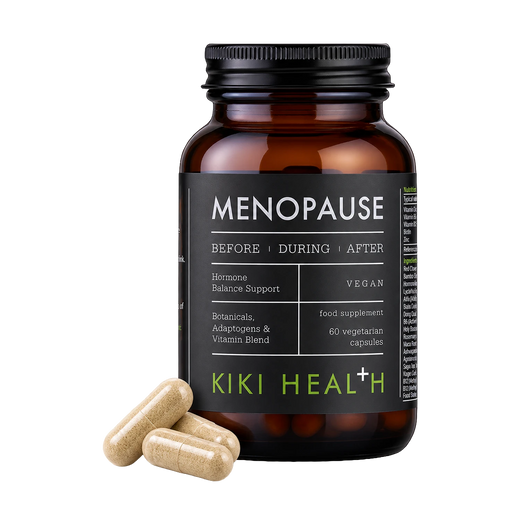
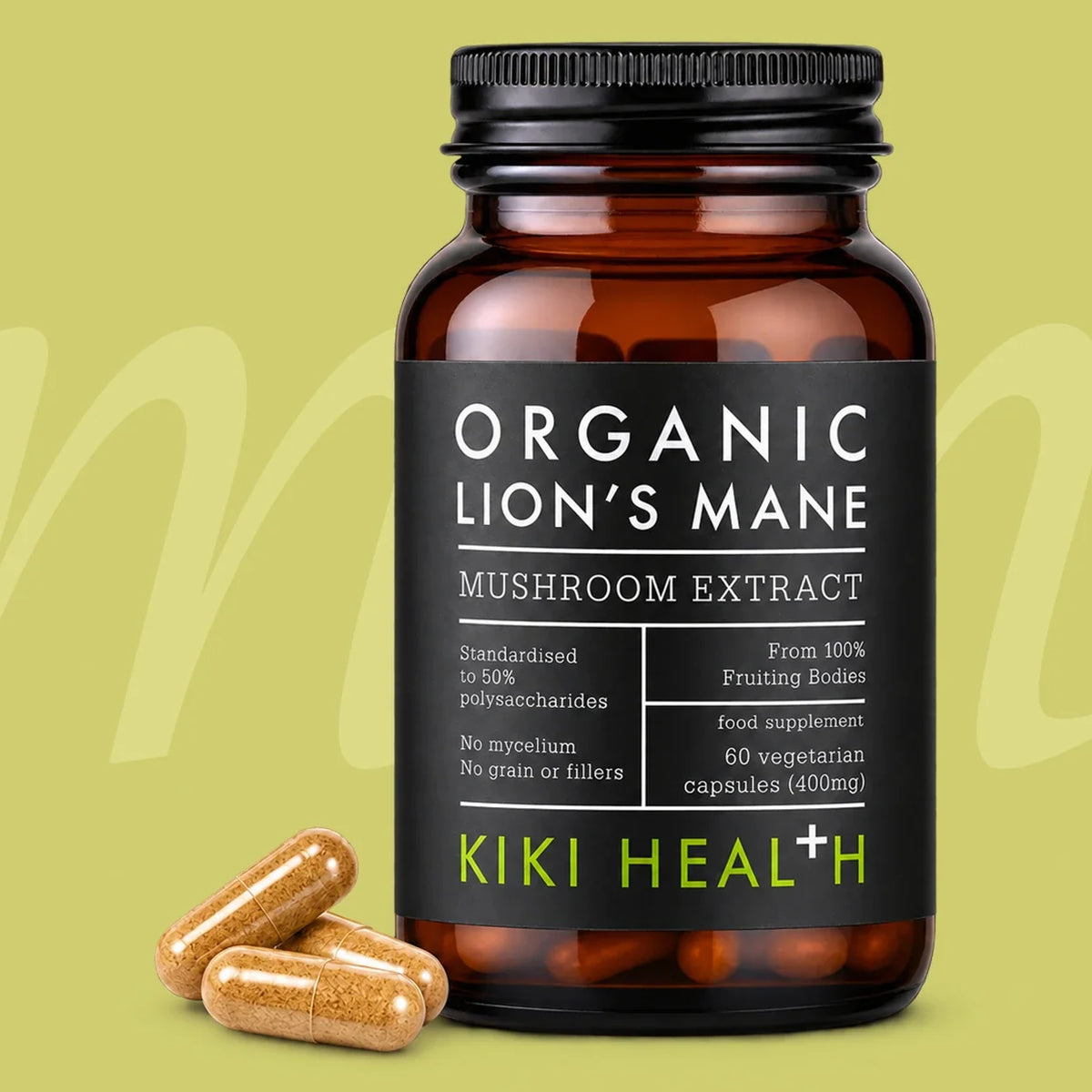
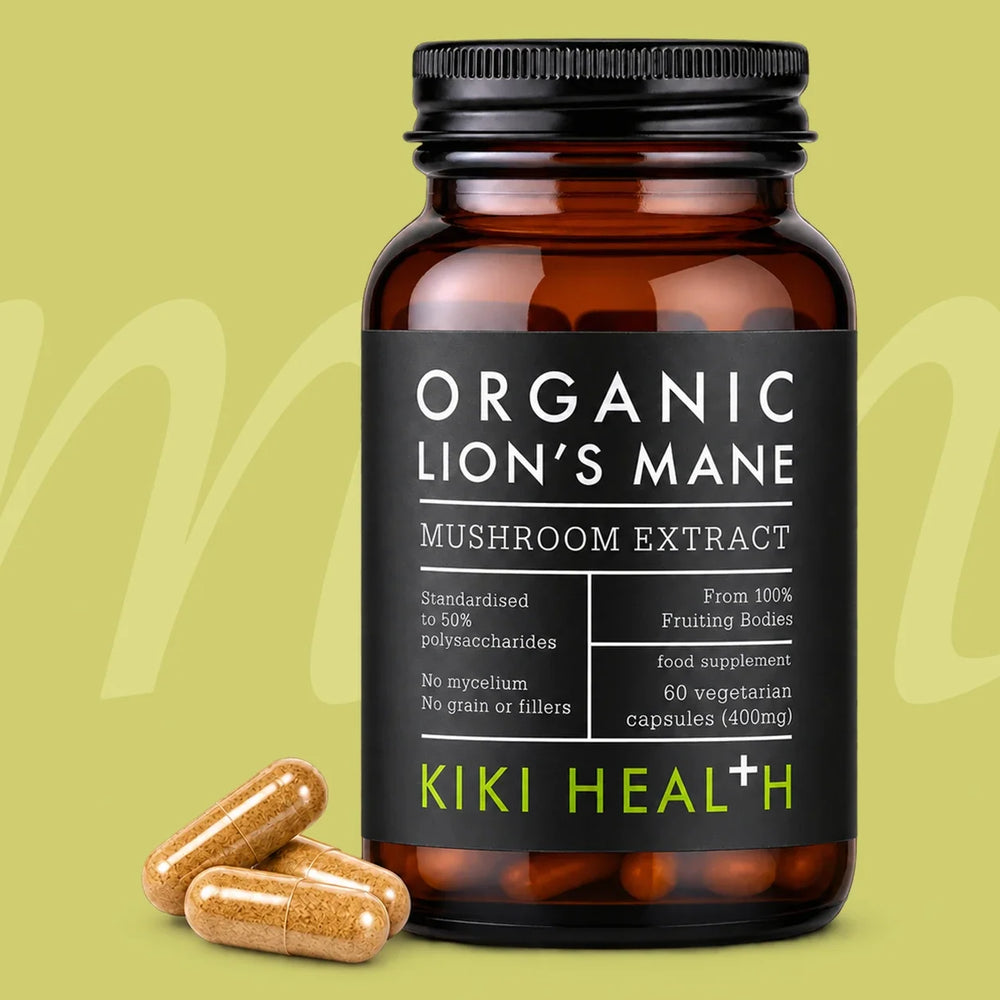
KIKI Health Organic Lion's Mane Mushroom Extract
KIKI Health's Organic Lion's Mane Extract Capsules are made using carefully selected, organically cultivated fruiting bodies grown on a natural, wood-rich substrate.
- 400mg organic Lion's Mane extract per capsule
- standardised to 50% beta-glucan-rich polysaccharides
- made exclusively from mushroom fruiting bodies
- hot-water extracted without organic chemical extraction solvents
- no mycelium, grains or starch
- no added fillers or binders
- suitable for vegans
Each capsule delivers a carefully prepared organic mushroom extract in a straightforward, convenient format.
An ingredient worth understanding
Lion's Mane brings together a long history of traditional use, a distinctive natural composition and a growing body of scientific research.
Studies exploring cognitive performance and the mushroom's naturally occurring compounds have produced interesting findings, providing a foundation for continued investigation.
For women taking a closer interest in their nutrition and wellbeing through midlife and beyond, understanding the ingredients they choose, how they are prepared and the research behind them can make all the difference.
KIKI Health's view is simple: choosing well starts with understanding what you are choosing.
Looking at cognitive support more broadly?Read our separate guide to supplements for focus, memory and mental clarity, including nutrients and multi-ingredient cognitive formulas.References
- Friedman M. (2015). Chemistry, Nutrition, and Health-Promoting Properties of Hericium erinaceus Lion's Mane Mushroom Fruiting Bodies and Mycelia and Their Bioactive Compounds. Journal of Agricultural and Food Chemistry. DOI: 10.1021/acs.jafc.5b02914
- NHS: Symptoms of menopause and perimenopause
- Mori K. et al. (2009). Improving Effects of the Mushroom Yamabushitake on Mild Cognitive Impairment: A Double-Blind Placebo-Controlled Clinical Trial. Phytotherapy Research. DOI: 10.1002/ptr.2634
- Docherty S., Doughty F. L. & Smith E. F. (2023). The Acute and Chronic Effects of Lion's Mane Mushroom Supplementation on Cognitive Function, Stress and Mood in Young Adults. Nutrients. DOI: 10.3390/nu15224842
- Sun et al. (2025). Extraction, Structural Characterization and Biological Activities of Polysaccharides Derived From Hericium erinaceus. Food Science & Nutrition. DOI: 10.1002/fsn3.71275
Expert ingredient, cultivation, extraction and formulation contribution supplied by KIKI Health. Presented in femme's editorial format. This article is for general information only and is not a substitute for individual medical advice. Check the current product label before use.